
Angle iron is one of the most frequently used steel sections in the construction, fabrication, renovation and industrial sectors. It is used in various structural applications such as frames, roofing structures, gates, grills, racks, sheds, stairs, platforms and various other non structural applications in Pakistan. Angle iron can be used in various construction projects due to its simple L-shaped profile, which provides strong support and allows for easy installation.
Many people are confused with this when they are purchasing angle iron, they purchase equal angle iron and unequal angle iron. At first glance, both appear similar but are used for different loads and different purposes. The right one can help to increase safety, minimise material waste and assist in project budgeting.
This guide by Tarmal Construction explains the clear difference between Equal Angle Iron and Unequal Angle Iron, Its uses, benefits and selecting the right one for construction in Pakistan.
What Is Angle Iron?
Angle iron is one kind of steel section in the shape of letter L. It has two legs or sides, which are connected at 90 degrees. Angle iron can be used in framing, bracing, support and connection work, as these two legs are used to provide strength in two directions.
In Pakistan constructions, angle iron is most frequently made of mild steel. It comes in various sizes, thickness and length. In certain instances, the angle irons are also galvanized to guard from corrosion, particularly in outside or damp regions.
Angle iron is highly favored due to its high level of ease of cutting, welding, drilling, bolting and installing. It can be applied to small projects at home or for large commercial buildings.
Equal Angle Iron is what?
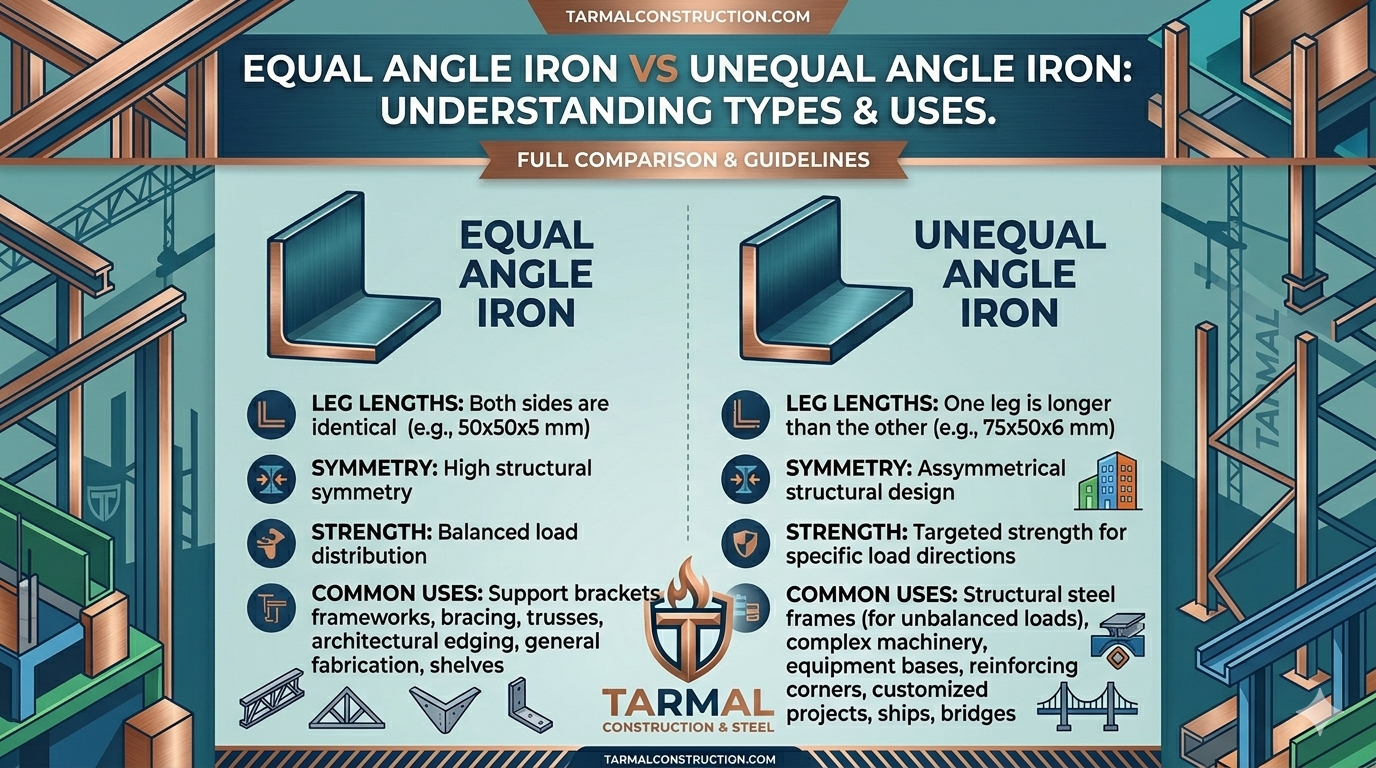
Equal angle iron is the name given to the iron with two equal legs. For instance, if one side is 50 mm, then the other side will be 50 mm. This provides a nice balanced shape and strength on both sides of the section.
Some common examples of equal angles are:
- 50 x 50 mm
- 65 x 65 mm
- 75 x 75 mm
- 100 x 100 mm
Depending on the strength requirement, a different thickness can be used. Thicker angle iron is used for heavier duty applications and thinner for lighter duty applications.
Equal angle iron can be used when the load is balanced or both sides require equal support. It is also simpler to join and include numerous general building jobs.
What is Unequal Angle Iron?
The legs of unequal angle iron are of unequal size. The side is for instance 75 mm and the other side 50 mm. This results in a section being stronger in one direction than the other.
Examples of unequal angles include:
- 75 x 50 mm
- 100 x 75 mm
- 125 x 75 mm
- 150 x 100 mm
In areas where a load is not evenly distributed, or where one side is to be supported more than the other, unequal angle iron is used. It is particularly useful for structural frames, brackets, supports and where space or load direction play a role.
Equal Angle Iron vs Unequal Angle: Main Difference
The main difference is the size of the two legs.
- Equal angle iron, both legs have the same size. Unequal angle iron is the one who is not equal in length. This minor change in design alters the behaviour of the steel with regard to loading, bending, fixing and supporting.
- Balanced support is provided by equal angle iron. Directional support is provided by unequal angle iron. This is because even angle iron is suitable for an equal load and unequal angle iron is suitable for unequal load or unequal reach.
If you are building a simple frame for a gate, for example, you may be able to use equal angle iron. However, if you are supporting a shelf, platform or edge beam that has a heavier load on one side of the structure, unequal angle iron may be the better choice of material.
Strength and Load Carrying Difference
Equal and unequal angle iron can be both strong and strong, but it depends on the size, thickness, steel grade and installation method of the angle iron.
Equal angle iron allows distributing strength evenly between both legs. This is ideal for square frames, braces, towers, light supports and general fabrication.
When using unequal angle iron, it is stronger on the longer leg. This will be helpful when the structure requires additional support in one direction. It is also beneficial in cases where the surface to be fixed is small, and the load to be supported is extended outward.
The selection should not be made just on the basis of appearance or cost for heavy construction. Load calculation, span, support condition, and safety factor must be checked. When doing important structural work, an engineer should always verify the correct size.
Equal Angle Iron Applications in Pakistan Construction
Because of its simplicity, balance and ease of installation, equal angle iron is widely used in Pakistan. It can be used in a variety of construction and fabrication applications.
1. Gates and Grills
Equal angle iron is widely used in the area of gate, window grill, boundary grill and security frame. It is designed to be balanced, making it easier to manufacture neat and sturdy frames. It also is suitable to use on flat bars, square pipes and decorative steel designs.
2. Roof Trusses and Sheds
Equal angle iron is used for bracing and support members in small commercial sheds, farm sheds, parking shades and roof trusses. It is used to regulate the movement and to provide stiffness to the roof structure.
3. Steel Frames
Equal Angle iron is used for creating frames for doors, windows, machinery bases, cabinets, work tables and storage racks. Both sides are identical, aligning and joining is simple.
4. Bracing Work
Steel structures are important due to resisting side movement. Equal angle iron is also used for diagonal bracing of towers, sheds, partitions and temporary supporting structures.
5. Stair and Platform Frames
Equal angle iron can be used as edge support or cross support in light stairs, landings and platforms. But, the right thickness and size have to be chosen depending on the load that is expected.
6. General Fabrication
Equal angle iron is used by many workshops in Pakistan on a daily basis for making fabrications. It can be used in the manufacture of bench, rack, signboard, frame, stand, and light industrial products.
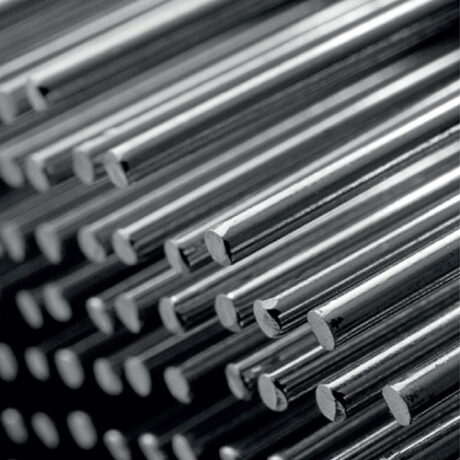
In Pakistan, Unequal Angle Iron is also Used for Constructing Buildings
When additional support is required on one side of the load or required by design, unequal angle iron is selected. Sometimes it is required for a simple job; however, it is very helpful in special construction and structural situations.
1. Structural Supports
Structural supports that require a different amount of stress across each side of the structure are made from unequal angle iron. Can be used in Frames, Brackets, Edge Supports, and Load Bearing Steel Connections.
2.Lintel and Edge Support Work
For some construction details, unequal angle iron can be used to support an edge, slab side or a masonry element. The extended leg can offer greater seating or support as necessary.
3. Heavy Duty Brackets
If brackets are required to support shelves, platforms, parts of machinery or wall mounted supports, unequal angle iron may be more suitable for resisting loads in a particular direction. The longer leg provides more contact area and load distribution.
4. Industrial Fabrication
Custom steel sections are needed in factories, warehouses, workshops and commercial buildings. Wherever required for superior fitting and strength, the unequal angle iron can be used.
6. Structural Integrity and Stability of the Building Envelope
For mezzanine floors, platforms or stair structures, unequal angles may be employed in those situations where one side is attached to a beam or wall and the other to the floor or a step load.
5. Frames with Offset Loads
Not all the frames carry a load at the center. If the load is offset or one sided the unequal angle iron may work better as it provides additional strength in the area of the higher load.
Equal vs Unequal Angle iron is Used in Construction in Pakistan
In Pakistan, equal and unequal angle iron are utilized in residential, commercial, and industrial constructions. Depending on the nature of the project, the right choice is the one that is suitable.
- Equal angle iron is sufficient for common house construction, grills, gates, light frames, etc. It is readily available in the local steel markets and easily used by fabricators.
- In most cases, unequal angle iron is used whenever the load specifics and machinery base, custom brackets, and warehouse structures are heavy supports. It provides greater direction of strength and fitability.
- Cost also matters. Equal angle iron may be more readily available, and thus easier to source. If particular dimensions and thickness are required, then attention should be paid to the selection of unequal angle iron.
- But the price is not the only consideration. An inferior section that is too weak may pose safety issues. If a section is too heavy, there is no tangible benefit and it costs more. The best way is to select based on load, design, location and long term performance.
Key Benefits of Equal Angle Iron
Several advantages of equal angle iron in the construction and fabrication.
- Easy to use, it comes in two sizes. Measuring, cutting, welding and fixing is easier. It also provides a neat and well-balanced appearance in exposed jobs like frames, grills, gates, etc.
- Steel is readily accessible in the steel markets of Pakistan. Common sizes can typically be found by contractors and fabricators with little delay. This will keep projects on track.
- It also works for a number of tasks that are done in general. Equal angle iron is used in daily construction and is suitable for various types of construction.
Key Benefits of Unequal Angle Iron
When the requirement is to have more strength or reach on one side of the design, unequal angle iron is a valuable option. A longer leg will offer more support, more fixing space, or more load resistance.
It is useful in structural applications when forces are different on each side. It may also help to minimize the requirement for extra plates or additional supports in certain designs.
Unequal angle iron provides greater flexibility in the case of custom construction projects. It enables engineers and fabricators to size the steel section to fit the load direction and space requirement.
Which Angle Iron is Better?
There is no one right answer as both types have benefits. Balanced loads and general fabrication, use equal angle iron. Unequal angle iron is more suitable for directional loads and special support conditions.
Use equal angle iron whenever:
- The strength of both sides must be equal
- The frame is square or balanced.The frame is square or balanced.
- The work is light to medium in nature.
- Must be readily fabricated
- Gates, Grills, Racks or simple frames are part of the project.
Use unequal angle iron when:
- One side is more heavily loaded.
- The support is one directional
- The design requires an increased length fixing leg.
- The structure has an offset loading structure
- The project will cover brackets, platforms, edge supports or custom steel work
Always check the size with a qualified engineer or construction team when performing significant construction activities.
Few Factors to Consider Before Buying Angle Iron
These are some of the points that should be taken into account before purchasing angle iron in Pakistan.
Size
The leg size should be the same as the requirement of the project. The small angle may not provide enough support and the oversized angle may be more costly.
Thickness
Thickness affects strength. Heavier load areas typically require more thickness of angle iron. Thinner sections might be sufficient for light fabrication.
Steel Quality
Poor quality steel has a shorter lifespan for bending, cracking or rusting. Always purchase from a trusted manufacturer and inspect the material prior to use.
Rust Protection
When used outdoors, painting or priming with a coat of galvanized paint is an option. Rust protection is more critical in coastal or moisture exposed areas.
Welding and Fixing
It is necessary to easily welded or bolted the angle iron as per requirement in the site. Bad welds can decrease the strength even if the steel section is good.
Load Requirement
The choice should be based on the anticipated load at all times. Use angle iron only as a guess when making structure.
Common Mistakes that Should be Avoided
A significant number of construction issues arise due to the use of the wrong steel section. One common mistake is using equal angle iron where unequal angle iron is needed for one sided load. This can cause the stem to bend or to lack support.
- The other error is selecting a thinner section which is cheaper but is unable to withstand the tensile forces. This can save money initially, but will increase repair costs and safety risks subsequently.
- Some people even neglect rust protection. In Pakistan, the outside steel can be exposed to rain, humidity, dust and weather changes. If not coated, angle iron may corrode and weaken over time.
- Another serious problem is poor welding. Strong angle iron will not last long if the joints are weak. The skill of the fabrication and installation is just as important as the material used.
The use of angle iron in residential construction.
Angle iron use is extensive in residential projects, both as part of the exterior look and within the interior, where it often forms an integral part of the structure. May be used in the gates, window grills, balcony railings, shade frames, rooftop construction, and storage racks.
Equal angle iron is generally employed in most house related steel works. Provides a clean look and adequate strength with many light to medium applications.
Unequal angle iron may be used in certain brackets, supports or loads. If, for instance, the wall mounted support requires increased strength on the projecting side, unequal angle iron can be used.
Angle Iron in C and I Works
A stronger and more carefully selected steel section may be required for commercial & industrial projects. Angle iron can be used in the roof trusses, platforms, machine supports, frames and service structures of warehouses, factories, workshops, shops and plazas.
Equal angle iron can be used for framing and bracing. Unequal angle iron is convenient under the condition of the unbalanced structure and the bearing side of the support is required to be longer.
In these projects, professional design is important. Using the wrong steel size can impact safety, performance, and maintenance cost.
Why Work With Tarmal Construction?
At Tarmal Construction, we know that the type of material used will influence the strength of a project, its cost, and its lifespan. Angle iron is a simple product, but the selection of the wrong angle iron can impact the entire structure.
We are dedicated to making practical construction decisions, selecting appropriate materials and achieving sustainability. No matter if it is a residential construction, commercial project, fabrication, renovation or structural support, the right steel section is always the right project.
By emphasising safety, quality and good planning, at the outset, Tarmal Construction clients are able to make much better construction decisions.
Final Thoughts
Both equal angle iron or unequal angle iron have an important role in Pakistan construction. Equal angle iron is suitable for balanced support, simple frame, gate, grill, bracing and general fabrication. Unequal angle iron is most suitable for edge supports, special brackets, industrial frames, structural details, and one sided loads where one leg requires greater strength or greater length.
It is determined by load, design, thickness, steel material, anti-rust and installation method. For short jobs, a skilled fabricator can recommend the choice. When it comes to structural projects, never go against an experienced engineer’s or trusted construction company’s advice.
When it comes to construction or fabrication projects in Pakistan, selecting the appropriate Latest Steel Price in Pakistan can offer cost savings, boost safety, and extend the lifespan of your structure. The team at Tarmal Construction has the expertise to assist you in choosing the right materials and ensuring your construction is done with confidence.
Visit For More : Tarmal Construction